Why Does My Tailbone Hurt? Understanding Coccydynia Beyond the Coccyx
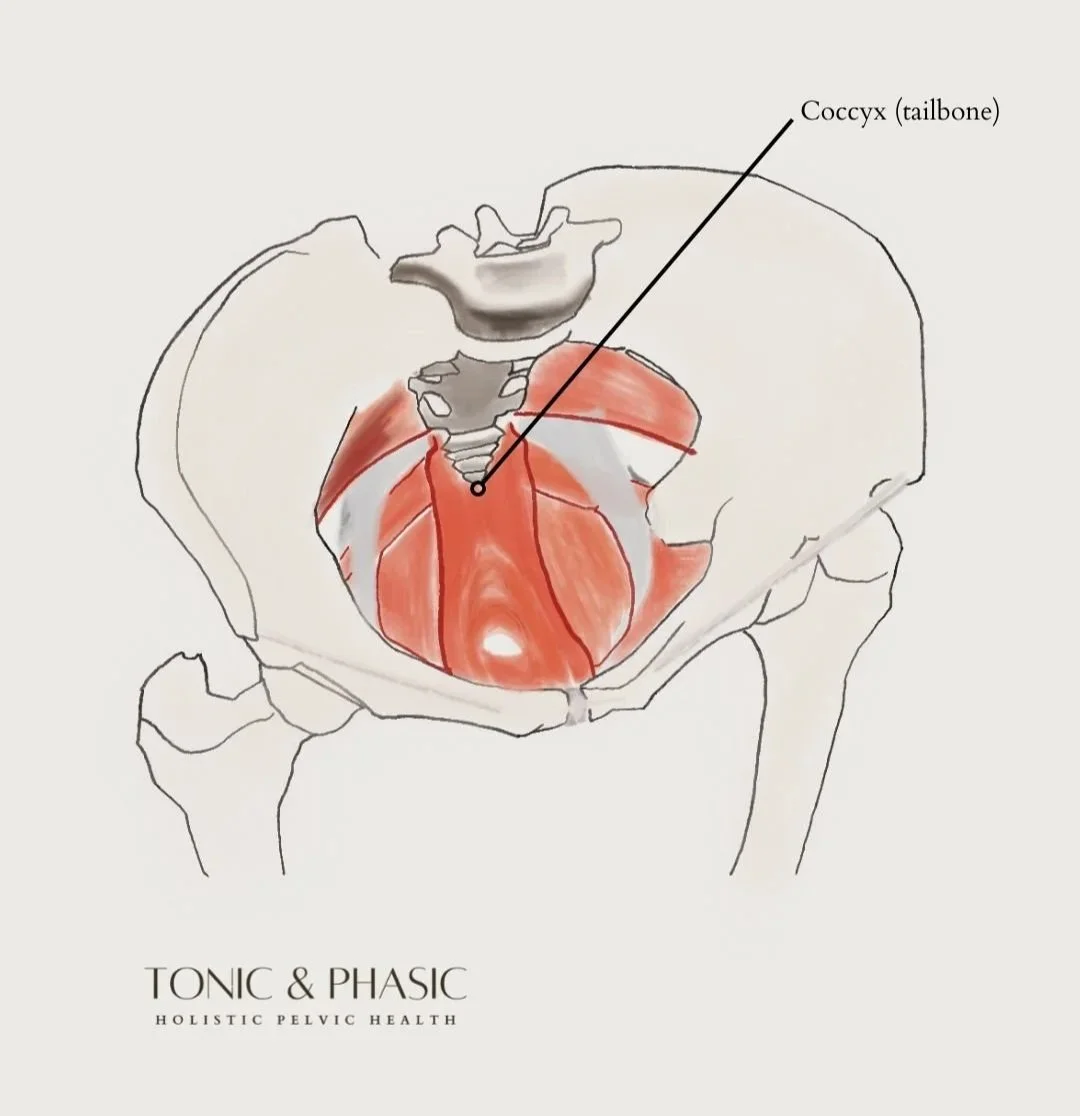
The coccyx, more commonly known as the tailbone, is a small but incredibly important anatomical structure located at the base of the spine. It is shaped somewhat like an upside-down triangle, formed by 3–5 small vertebral segments that gradually taper from a wider base to a smaller apex.
Although small, the coccyx has significant connections throughout the body. It attaches to the sacrum through the sacrococcygeal joint and serves as an anchor point for multiple ligaments, muscles, and pelvic floor structures. The anococcygeal ligament connects the coccyx to the external anal sphincter, while fibers from the sacrospinous and sacrococcygeal ligaments run nearby and attach into the area. Portions of the gluteus maximus also connect to the coccyx, and perhaps most importantly, the deep pelvic floor muscles attach directly to it as well.
Because of these connections, the coccyx is influenced by much more than just the tailbone itself. The hips, sacrum, lumbar spine, pelvic floor, glutes, hamstrings, adductors, abdominal wall, and surrounding tissues can all place forces through the coccyx. Even bowel health and constipation may contribute, as stool must pass through the rectum and external anal sphincter, structures closely related to the pelvic floor and tailbone region.
This means that when muscles become overly tense, weak, unstable, guarded, or imbalanced anywhere along the chain of the body, stress can be transferred into the coccyx and contribute to tailbone pain.
What Does Tailbone Pain Feel Like?
Tailbone pain, also known as coccydynia, is often felt during:
Sitting
Standing from sitting
Bending forward
Core exercises performed on the back, such as crunches
Prolonged pressure through the tailbone
After a fall directly onto the buttocks
If you have experienced tailbone pain, you know how frustrating and disruptive it can feel. Sitting, standing, bending, exercising, driving, and even relaxing can become uncomfortable because the coccyx is involved in so many daily movements and positions.
Why Does Tailbone Pain Happen?
Tailbone pain is rarely just the tailbone.
Many people are told their coccyx is misaligned, but often the bigger picture involves the surrounding muscles, joints, connective tissues, and nervous system that are influencing the position and tension around the coccyx.
Think of the body like a tent. The coccyx is one small point within the structure, while the muscles and connective tissues surrounding it act like tension cables. If certain cables become too tight, too weak, or pull unevenly, tension is transferred through the structure and can alter how the coccyx moves and tolerates pressure.
This is why simply trying to “put the tailbone back into place” is often not the most accurate way to describe treatment. The body is made up of interconnected muscles, joints, ligaments, and movement patterns, and we cannot simply force one structure into position without considering the forces surrounding it.
We cannot simply force one structure into position without considering the forces surrounding it.
Instead, the goal is to address the tissues and movement patterns contributing to stress on the coccyx so those same tension patterns do not continue pulling on the area.
Treatment often focuses on reducing tension, improving mobility and support around the pelvis, restoring movement variability, and allowing the coccyx to move more freely without excessive strain.
Can Pelvic Floor Therapy Help Tailbone Pain?
In many cases, yes.
Research has shown that conservative treatment for coccydynia is highly successful. In a review by Lirette et al., conservative treatment was reported to be successful in approximately 90% of cases, with many people improving even without invasive medical intervention.
Pelvic floor physical therapy can be especially helpful because of the direct relationship between the coccyx, pelvic floor muscles, hips, sacrum, spine, and nervous system.
What Happens During Pelvic Floor Physical Therapy for Tailbone Pain?
Treatment begins with a full-body assessment rather than focusing only on the tailbone itself.
At Tonic & Phasic Holistic Pelvic Health, this may include assessing:
Hip mobility and stability
Lumbar spine movement
Sacral and pelvic mobility
Tailbone mobility and tenderness
Pelvic floor muscle coordination and tension
Core and breathing mechanics
Gluteal, hamstring, and adductor involvement
Sitting posture and movement patterns
Nervous system sensitivity and guarding
The goal is to understand why stress is being transferred into the coccyx and what structures may be contributing to the tension pattern.
Treatment may include:
Manual therapy
Pelvic floor downtraining or coordination work
Mobility exercises
Stability and strengthening exercises
Breathing and pressure management strategies
Nervous system regulation techniques
Ergonomic and biomechanical modifications
Movement retraining for sitting, bending, lifting, and exercise
Pain that has lasted for a long time can also create anticipation of pain, fear of movement, and protective guarding patterns within the nervous system. Part of recovery is helping the body rebuild trust and confidence in movement again.
Common Exercises Used for Tailbone Pain
Every treatment plan should be individualized, but some common foundational exercises may include:
Pelvic drops with lacrosse ball release
Figure-4 stretch variations
Cat-cow mobility
Yogi squat variations
Sacroiliac joint (SIJ) mobility drills
Pelvic and breathing coordination exercises
Hip and pelvic mobility work
The overall goal is to improve movement variability and reduce excessive tension around the pelvis and coccyx.
Tailbone Pain Is Real; And Treatable
Tailbone pain can feel isolating, frustrating, and difficult to explain, especially because sitting and daily movement are unavoidable parts of life. But the coccyx does not function in isolation, and treatment should not focus on the tailbone alone.
By looking at the body as an interconnected system, including the pelvic floor, hips, spine, musculature, movement patterns, and nervous system, pelvic floor therapy can help uncover the drivers contributing to pain and support a more comprehensive path toward healing.
If you are experiencing persistent tailbone pain, know that there are options, and you do not have to navigate it alone. Book your free discovery call today to learn more about how Tonic & Phasic can help you recover from tailbone pain.
Medical Disclaimer
This blog is intended for educational purposes only and does not constitute medical advice, diagnosis, or treatment. Always consult with your physician or qualified healthcare provider regarding your specific recovery, symptoms, or medical concerns.